 Pecan
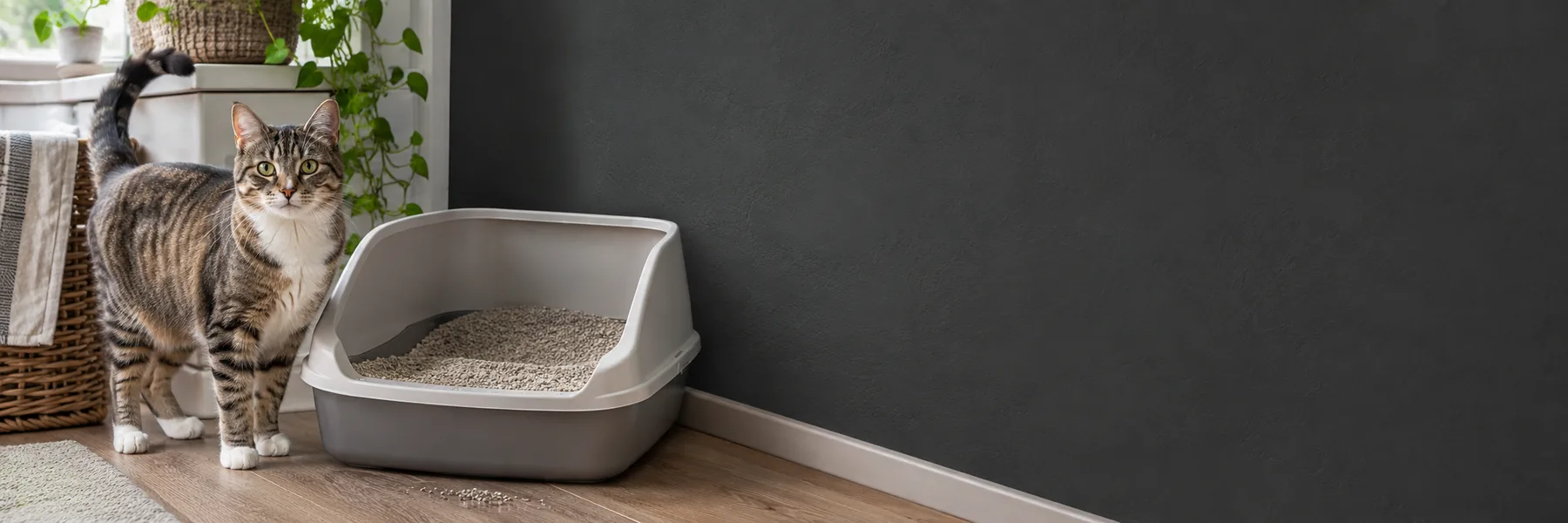
A covered litter box may look neater in a room. That does not tell you whether your cat will want to enter it. High sides can contain litter kicked out during digging, but may make entry awkward for an older cat. Before comparing box designs, ask three more useful questions: can your cat turn around inside, is the entrance comfortable, and how is the litter getting onto the floor?
If your cat uses its current box comfortably and consistently, a new one is not automatically an improvement. Watch one visit if you can: does the cat have room to turn and dig, or does it have to squeeze against the sides? Cats Protection notes that cats differ in their preferences and that size, location and cleanliness all matter.
Measure the space the cat gets, not the outside of the box
A wide rim or a lid can make the external dimensions look generous while reducing the usable space inside. Measure the interior length. International Cat Care gives a useful guideline: a box about one and a half times the length of the cat from nose to base of tail. That is a starting point for ruling out cramped boxes, not a guarantee that any particular model will suit your cat.
Check the height of the entrance separately. A cat with limited mobility may need a low step even if high walls would make cleaning the floor easier for you. A spacious box with an entrance the cat avoids has not solved the problem.
Notice *when* the litter escapes
If digging sends granules over the sides, a box with high walls and an open top is worth considering. Pecan lists a semi-enclosed, high-sided litter box. Check its usable interior dimensions and entry height before ordering, especially for a large or older cat. A product described as “large” may still leave too little room inside.
Litter that drops from paws *after* the cat leaves is a different issue. A double-layer litter mat may be the more relevant product, provided it lies along the cat's actual route out of the box and is easy to empty. It is intended to catch loose granules; there is no basis to promise that it deals with urine on the floor or odour.
An ordinary open box remains a good choice when the cat has enough room and uses it happily. It is easy to see when it needs cleaning, and there is no flap or narrow doorway to negotiate. For a few granules near the entrance, changing the box may be more disruption than the problem warrants.
Does a lid help?
Some cats use covered boxes readily; others feel too enclosed. A hood can also hold smells inside even when the outside looks tidy. It does not replace regular scooping and washing. Cats Protection advises removing a swinging flap from a covered box because it can put cats off entering. Pecan carries a stainless-steel litter box with a cover, but its material and lid alone say nothing about whether a cat will prefer it. Check the usable height and length, the entrance and what comes with the selected option.
If you do try a new shape, offer it alongside the familiar box. Keep the litter type and location as familiar as possible at first. Changing the box, litter and position on the same day makes it hard to tell what the cat dislikes. One successful visit to the new box is not a reason to remove the old one immediately.
The choice can be fairly straightforward: keep an open box if it fits and works; consider high sides if digging throws litter out and entry remains easy; try a cover only if the interior is roomy and the cat chooses to use it. Granules carried out on paws call for attention to the exit area, not necessarily a different box.
In a home with more than one cat, also think about number and location. Cats Protection recommends one box per cat plus one extra, spread around the home. Several boxes in a single row do not offer the same access as boxes in separate places. A quiet, reachable spot away from food and water may matter more than the lid. Leave yourself enough room to pull the box out and clean around it, too.
If a cat suddenly stops using a previously familiar box, starts relieving itself beside the box or changes its habits, do not treat the problem as a shopping decision alone. Cats Protection recommends a veterinary check first to rule out a medical cause. After that, it is easier to assess whether the box, litter or location needs to change.
Further reading: Cats Protection, Cats & Toileting; International Cat Care, kitten care booklet.