 Pecan
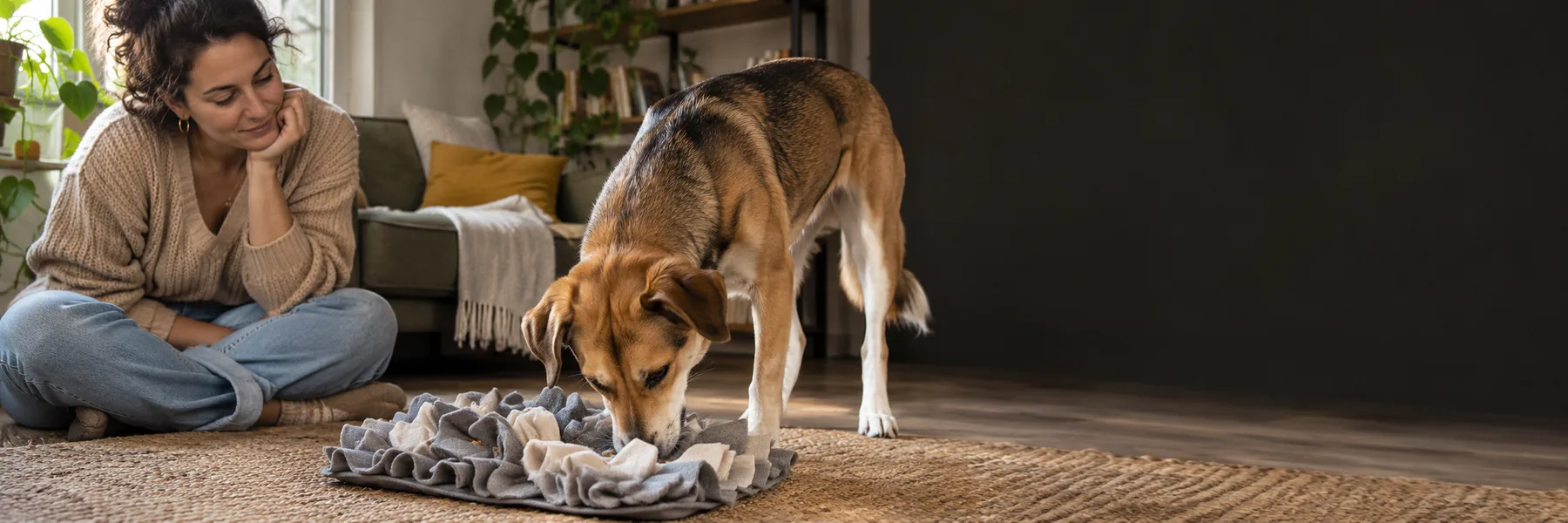
One dog will spend ages tracking down a piece of kibble that rolled under a chair. Another will take one look at a food puzzle and bring you a ball instead. That is a better place to start than a toy's promise to keep every dog entertained. Watch what yours already chooses to do: sniff, work something open, or play with you.
You can test those three interests at home before ordering anything. Offer an easy version of each activity while you're there to watch. Notice whether the dog tries again after a small success, asks for more, or walks away. A dog that ignores a puzzle has not failed an intelligence test. The puzzle may be too difficult to introduce that way, or it may simply be less interesting than a scent game.
Give the nose an easy win
Put a few pieces of the dog's usual food on the floor, a short distance apart. Once finding them is effortless, place one partly behind a chair leg or beneath the edge of a towel. The dog should still be able to reach it without having to move furniture. The ASPCA's scent-game guide starts with a nearby treat and makes the search harder gradually.
If that kind of search holds your dog's attention, a snuffle mat offers fabric folds to hide food in. It is not a sensible unattended chew toy for a dog that pulls fabric apart or swallows loose pieces. Before buying, check its dimensions and washing instructions, especially if you have nowhere to dry it flat. Clean food-hiding areas after use.
A puzzle asks for a different skill
In a scent game, the food is found by following a smell. In a food puzzle, the dog has to move part of the toy to release it. Make the first attempt almost obvious: leave a compartment open, or move a cover slightly aside. Let the dog see one piece come out. Close the compartment only after it has understood what the movement does. If it starts biting the whole toy, try an easier setup rather than assuming more difficulty will make the game more exciting.
Pecan lists a food puzzle and a wobbling treat dispenser. The second rewards nudging the toy across the floor, while the first involves reaching food through its puzzle mechanism. Check the dimensions and compatible kibble size before choosing either toy; an opening that works for one type of food may not work for yours. A dispenser that empties at the first nudge, or refuses to release the food at all, misses the point. Check the opening and how the toy is meant to be filled.
Using some of the dog's regular meal in a game can be simpler than adding treats on top of it. If your dog follows a prescribed diet, keep to the feeding advice you already have. A food toy still needs cleaning, particularly where crumbs can remain behind a moving part.
Sometimes the game is you
Fetch, tug and short training games give a dog something a puzzle cannot: your participation. If yours already loves chasing a ball, a few short throws in a suitable open space may be all the equipment needed. Pause between rounds. A dog that is tired, startled or no longer interested does not need another throw.
There is a rechargeable ball launcher in the catalog for dogs that already enjoy fetch. Before ordering, check the launch distance, the diameter of the supplied ball and whether that ball is suitable for your dog's size. Use it only where a launched ball will not cross a path or road, and stay with the dog. An automatic launcher cannot tell you when play has stopped being fun.
Check the toy before adding it to the basket
A colourful product picture cannot tell you whether filling and cleaning a toy will be easy, or whether your dog will try to play with it as intended. Look at how it opens, whether parts can come loose during play, and where food might remain afterwards. If your dog tends to dismantle toys, favour an activity you can do together and stop when necessary. And if a simple search or a ball you already own still holds its interest, there is no need to buy a new device for the sake of variety.
Once you know whether your dog returns to sniffing, working a mechanism or playing with you, the choice is smaller and clearer. The best activity does not need to look impressive on camera; it needs to make sense for the dog in front of you.
Further reading: ASPCA, Canine DIY Enrichment.