 Pecan
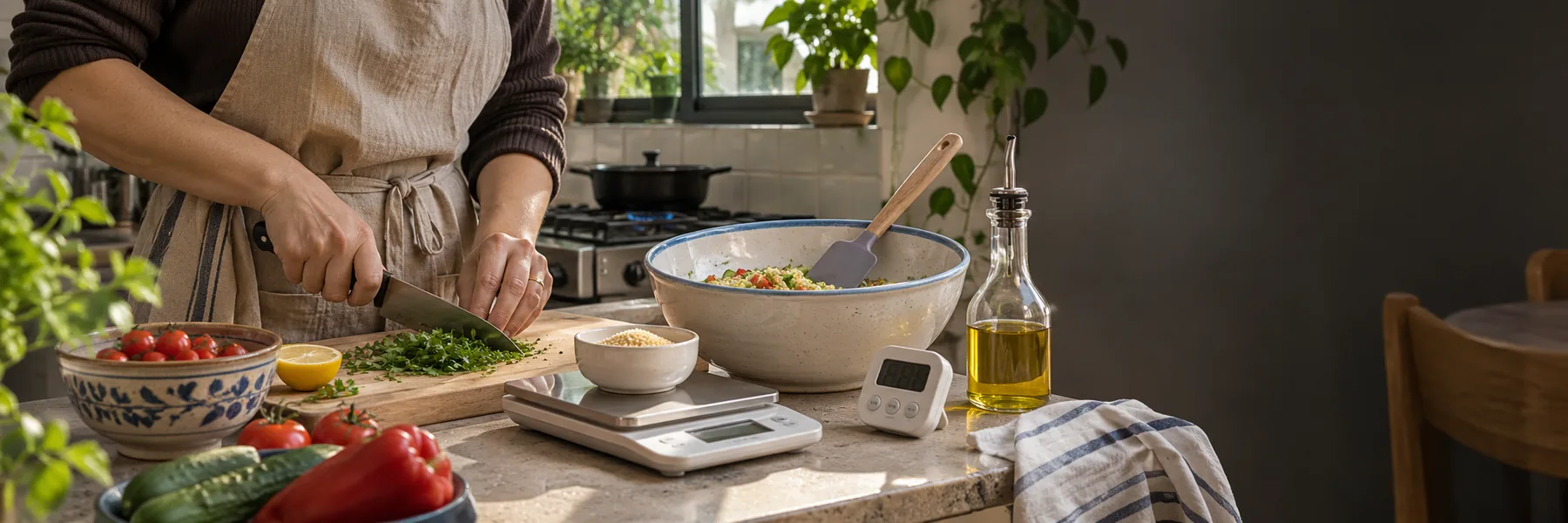
The video of a vegetable chopper ends when the onion is diced. In your kitchen, somebody still has to wash the container, dry the lid and find room for both. A useful tool is one you would happily reach for on a busy Tuesday, not simply one that looks clever for ten seconds.
These seven tools address different hold-ups in a meal. They are options, not a starter kit. Notice which task repeatedly slows you down, then decide whether the tool saves enough effort to earn its storage space.
Before the stove goes on
1. A hand-powered chopper for repeated small jobs. A pull-cord chopper spins blades inside a container without needing an outlet. It may be handy for small amounts of onion, garlic or herbs when taking out a full-size processor seems excessive. You still need to cut ingredients small enough to fit and wash the blades carefully. A knife gives you more control when you want distinct, even pieces.
2. A kitchen scale when the recipe uses grams. Measuring cups work for recipes written in cups; they are not a substitute for a weight measurement. A digital kitchen scale is especially useful for baking or for recreating the same recipe consistently. Check its measuring range, platform size and whether it can reset to zero with a bowl on top. If you mostly cook by sight and taste, it may spend more time in a drawer than on the counter.
While several things are happening at once
3. A timer you can see without finding your phone. When a tray is in the oven and a pan needs attention, a separate kitchen timer can stay visible from where you cook. Placement matters more than a long feature list: can you see its display and hear it from that spot? An oven clock that already does both serves the same purpose.
4. A spatula for what sticks to the bowl. A flexible silicone spatula scrapes batter or sauce from the side of a bowl and transfers it without chasing the last spoonful around. Check that its handle suits the bowls and pans you own. For hot food, consult the exact model's heat instructions rather than assuming every silicone utensil has the same limit.
5. A thermometer when appearance cannot tell you enough. A folding food thermometer takes a reading where its probe enters the food. USDA Food Safety and Inspection Service guidance generally recommends the thickest part, away from bone and fat. Check the safe target temperature separately for the food you are cooking. A folding handheld probe should not be left in the oven unless its manufacturer specifically allows it.
Storage and serving have their own bottlenecks
6. A colander that collapses after use. A collapsible colander still takes up space while vegetables or pasta are in it. Its advantage appears when it is dry, folded and back in the drawer. Compare the open size with what you normally rinse, and the folded size with the drawer you intend to use.
7. One oil bottle for pouring and spraying. A dual-function oil bottle may suit a cook who wants to pour oil into a pan and spray it across a tray. Spraying is not a precise measure of how much oil was used. The spout also needs filling and cleaning. If you only pour oil, the extra mechanism solves no recurring problem.
Think of a meal you cook once or twice a week. Which step repeatedly makes you improvise, wash an extra item or check your phone with messy hands? Start with a tool for that step. If you reach for it again the following week, it has probably earned its drawer space.